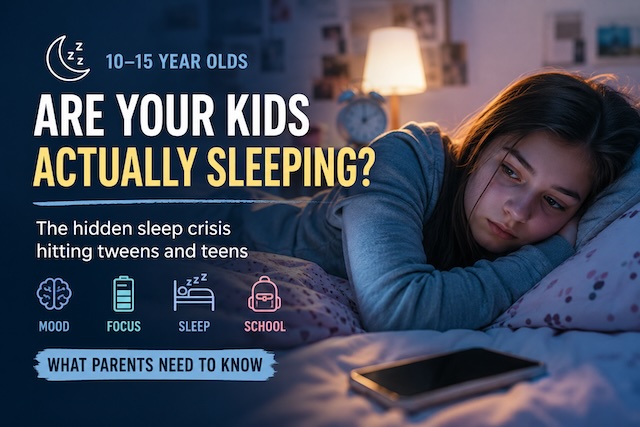
Are Your Kids Actually Sleeping? The Hidden Sleep Crisis Hitting 10–15 Year Olds
Pediatric sleep specialists are warning about a growing “hidden sleep crisis” among tweens and teens — and many families may not even realise it’s happening.
Your child falls asleep fine. They don’t constantly complain about being tired. They seem… mostly okay.
So why are so many parents noticing the same things lately?
- Mood crashes after school
- Constant exhaustion in the mornings
- Difficulty focusing on homework
- Weekend sleep-ins that somehow never seem to help
It turns out, getting enough hours of sleep and actually getting good-quality sleep are two very different things. And according to sleep experts, many children aged 10–15 are now struggling with something called social jetlag.
What Is Social Jetlag?
Social jetlag happens when your child’s body clock — their natural circadian rhythm — becomes completely out of sync with their actual sleep schedule.
Think of it like travelling between time zones every single week. Except the “flight” is your teenager sleeping until noon on Saturday and then suddenly trying to wake up for school again on Monday morning.
Research consistently shows that tweens and teens naturally fall asleep later and wake up later compared to younger children and adults. But early school schedules, screen exposure, and dramatic weekend sleep catch-ups can throw their body clocks completely off balance.
The result? A child who technically spends enough time in bed — but still wakes up exhausted, groggy, irritable, and mentally drained. Sound familiar?
Signs Your Child Might Be Sleep-Deprived (Even If They’re Not Yawning)
Many parents assume sleep deprivation always looks obvious. But in tweens and teens, the signs are often much more subtle.
Watch out for:
- Mood crashes in the late afternoon
- Difficulty concentrating during homework or revision
- Falling asleep within minutes of lying down
- Sleeping dramatically later on weekends compared to weekdays
- Increased reliance on caffeine or sugary drinks
- Constant irritability or emotional sensitivity
- Waking up unrefreshed even after a “full” night’s sleep
For many families, these symptoms are quietly becoming normal — which is exactly why experts are becoming concerned.
The Weekend Lie-In Trap
Here’s the uncomfortable truth many parents don’t realise:
That generous weekend sleep-in you allow because your child “needs to catch up” may actually be making things worse.
Every extra hour of weekend sleep shifts the body clock further. By Sunday night, many teens genuinely struggle to fall asleep at a reasonable hour. Monday morning becomes exhausting, and the cycle repeats again.
This doesn’t mean you need to wake your 14-year-old at 7am every Saturday. But sleep specialists generally recommend limiting weekend lie-ins to around 60–90 minutes beyond normal weekday wake times to avoid disrupting the body clock too dramatically.
What Actually Helps
The good news? Most teen sleep problems respond surprisingly well to simple, consistent habits. Here’s what experts say makes the biggest difference:
1. Consistent Wake Times Matter More Than Bedtimes
Waking up at roughly the same time every day helps stabilise the body clock much faster than simply forcing an earlier bedtime. Start here before changing anything else.
2. Morning Light Exposure Is Powerful
Natural light within 30 minutes of waking helps reset circadian rhythm and improves alertness throughout the day. Even just opening the curtains immediately after waking makes a difference.
3. Keep Devices Out of the Bedroom
It’s not just about screen time — it’s also about stimulation, notifications, and blue light exposure affecting deep sleep quality. Charge phones in a communal area overnight. It’s one of the single highest-impact changes you can make. If your child is also spending significant time on social media, you may want to read about why governments are now stepping in to restrict access for under-15s.
4. Build a Proper Wind-Down Routine
A 20-minute “buffer zone” before bed helps signal to the brain that it’s time to switch off. That means:
- No stressful conversations
- No intense gaming
- No endless scrolling
- No homework panic at 11pm
Simple and consistent beats perfect every time.
5. Don’t Panic About Occasional Bad Nights
Ironically, anxiety about sleep often makes sleep worse. If a child genuinely can’t fall asleep after 20–30 minutes, experts say it’s often better to briefly get up, do something calm, and reset — rather than lying there becoming increasingly frustrated.
When Should Parents Be Concerned?
If your child consistently struggles to fall asleep, wakes repeatedly during the night, snores heavily, shows significant daytime sleepiness, or cannot function properly during school hours — it may be worth speaking with your GP or paediatrician.
Conditions like anxiety-related insomnia, delayed sleep phase syndrome, and sleep apnoea in teens are more common than many parents realise — and are often very treatable.
The Bigger Picture
Modern kids are balancing more than ever before — school pressure, sports, social media, constant notifications, and rising academic expectations. Sometimes what looks like laziness or a bad attitude is actually a child running on genuinely poor-quality sleep.
Helping kids build healthier sleep habits may quietly improve mood, focus, emotional regulation, motivation, school performance, and overall wellbeing. Small changes really can make a meaningful difference.
📋 Quick Summary for Parents
- Many teens get enough hours but still wake exhausted — quality matters as much as quantity
- Social jetlag is a real and growing problem, driven by inconsistent sleep schedules
- Weekend lie-ins beyond 90 minutes extra can make Monday mornings significantly harder
- Consistent wake times and morning light are the two most effective starting points
- Devices out of bedrooms overnight is one of the highest-impact changes you can make
- If problems persist, speak to your GP — teen sleep disorders are common and treatable
📥 Free Printable Resources for Families
Looking for practical tools to help build healthier routines at home? We have free printable study planners, habit trackers, fitness trackers and more — all ready to download, no sign-up needed.